
BEFORE WE ARE HISTORY
Four plays. Three programs.
October 23–November 8, 2026
One generation whose stories must not be forgotten.
In the early years of the AIDS epidemic, playwrights responded to a world that seemed to be changing overnight. They wrote about fear, desire, anger, friendship, abandonment, and love. They wrote about people fighting to survive, and about a society that too often turned away.
Forty years later, many of these plays have virtually disappeared from our stages.
BEFORE WE ARE HISTORY brings four remarkable works back to the theater, not as historical artifacts but as living, breathing stories that still have the power to provoke, surprise, entertain, and move us.
Presented in the intimacy of Open Space Arts' 25-seat storefront theater, this special series pairs two short plays, offers a new production of a groundbreaking work by Robert Chesley, and presents a rare staged reading of a play about friendship and chosen family.
Together, they ask a deceptively simple question:
What happens to our history when we stop telling its stories?
BLOOD SPILL / ONE
BLOOD SPILL (2014) by Lee Raines and ONE (1983) by Jeff Hagedorn confront the AIDS era through love, fear, anger, memory, and survival.
JERKER
Robert Chesley’s 1986 landmark play traces the intimate relationship between two gay men who connect by telephone during the early years of the AIDS crisis.
A QUIET END
Robin Swados’ 1985 play is a moving portrait of friendship, caregiving, and chosen family among men living through the AIDS epidemic.
two short plays October 23 t0 25
BLOOD SPILL / ONE
Two short plays presented together
ONE (1983) by Jeff Hagedorn
BLOOD SPILL (2020 - 2026) by Lee Raines
Friday, October 23 — 7:30 p.m.
Saturday, October 24 — 7:30 p.m.
Sunday, October 25 — 3:00 p.m.
What happens when we put one of the first plays written about AIDS alongside a play written three decades later?
We discover how much has changed—and how much remains painfully familiar.
ONE, written by Chicago playwright Jeff Hagedorn in 1983, takes us back to the terrifying beginnings of the epidemic, when even the name of the illness was uncertain and a diagnosis could mean entering a world of isolation, confusion, and fear.
At its center is a young man confronting a frightening new reality. He struggles to understand what is happening to his body and what it will mean for his relationships, his future, and his place in a society increasingly consumed by panic and misinformation.
Hagedorn was writing almost in real time, documenting a catastrophe whose full dimensions were not yet understood. He died of an AIDS-related illness in 1995, leaving behind a work that remains a powerful testament to those first terrible years.
First produced in Chicago in 1983 by Lionheart Gay Theatre Company, under the leadership of producer Rick Paul, Jeff Hagedorn's ONE is among the earliest theatrical responses to the emerging AIDS crisis. Written when fear, uncertainty, and misinformation surrounded the disease, the play captures an extraordinary moment in LGBTQ history.
BLOOD SPILL, by Lee Raines, approaches the crisis from another perspective.
Set in 1992, the play introduces Kenny King, an HIV-positive playwright who has written a fiercely personal script about AIDS. He brings it to Angela Turner, an old college friend who has become the successful head of a New York theater. Kenny wants his play produced. Angela isn't convinced.
What begins as a reunion between old friends becomes a sometimes funny, increasingly uncomfortable confrontation over artistic responsibility, race, institutional power, and who gets to decide which stories deserve an audience. Behind their argument lies a much larger question: What responsibility do artists and theaters have when a community is fighting for its survival?
Raines, a longtime HIV survivor and former ACT UP activist, writes with the urgency of someone who understands the political and personal stakes. BLOOD SPILL was developed through Write It Out!, a playwriting program founded by Donja R. Love to amplify the voices of writers living with HIV. Raines, who was diagnosed in 1989 and participated in the program's inaugural class, now serves as its Director of Artistic Programming and Outreach. His work creates a living connection between the AIDS activism of the past and the ongoing struggle against stigma and silence.
Presented together, the two plays create an extraordinary conversation across generations. One captures the shock of an epidemic just beginning. The other examines the struggle to make that experience visible while the crisis is still unfolding.
They remind us that theater can be more than entertainment. Sometimes it is a way of bearing witness. Sometimes it is an act of resistance.
ONE is directed by Rory Brady and performed by Sandro Fullone.
BLOOD SPILL is directed by David Zak and features Keith Butler and Tierza Scaccia.
Performances: Friday and Saturday, October 23–24, at 7:30 p.m.; Sunday, October 25, at 3 p.m..

Keith Buter and Tierza Scaccia in BLOOD SPILL.
NINE PERFORMANCES OCTOBER 29 TO NOVEMBER 8
JERKER
A landmark play by Robert Chesley
Created and performed by Jason Bowen and Joshua Bowen
Thursday, October 29 — 7:30 p.m.
Friday, October 30 — 7:30 p.m.
Saturday, October 31 — 7:30 p.m.
Sunday, November 1 — 3:00 p.m.
Monday, November 2 — 7:30 p.m.
Thursday, November 5 — 7:30 p.m.
Friday, November 6 — 7:30 p.m.
Saturday, November 7 — 7:30 p.m.
Sunday, November 8 — 3:00 p.m.
Funny, sexually explicit, provocative, and unexpectedly tender, Robert Chesley's JERKER remains one of the most remarkable works to emerge from the AIDS era. First produced in 1986, the play begins with two men connecting through telephone sex. They have never met. They know very little about each other. Their conversations are anonymous, imaginative, playful, and often outrageously erotic.
As they continue calling, however, something begins to change. Between the fantasies and sexual games, the men reveal fragments of their everyday lives, their insecurities, their humor, and their growing affection. Without ever sharing a physical space, they begin to create something that looks remarkably like a relationship.
And outside those conversations, the AIDS epidemic is transforming their world.
Chesley, who died of AIDS-related complications in 1990, was an outspoken defender of gay sexuality at a moment when fear and shame dominated much of the public conversation about gay men.
Rather than retreat from sexual expression, he placed it at the very center of his work. He insisted that pleasure, desire, laughter, and intimacy were essential parts of gay life and deserved to be celebrated, even in the shadow of death.
That insistence made JERKER controversial. It also made the play revolutionary.
But what may surprise contemporary audiences most isn't its explicit language or sexual frankness. It is the tenderness of the relationship that gradually emerges.
Beneath its provocative surface, JERKER is a profoundly human story about loneliness, companionship, vulnerability, and the courage it takes to love another person.
Robert Chesley was among the first American playwrights to confront the AIDS crisis directly. His groundbreaking NIGHT SWEAT (1984) was one of the earliest full-length plays about AIDS. Two years later, JERKER challenged censorship and conventional attitudes toward gay sexuality, insisting that intimacy, desire, and love remain essential even in the face of death. Chesley died of AIDS-related complications in 1990 at age 47. This 40th-anniversary production honors both his artistic legacy and the generation whose lives he documented.
For this special 40th-anniversary production, Open Space Arts brings together Jason Bowen and Joshua Bowen, who are husbands in real life. Jason's Chicago theater career includes founding Quest Theatre Ensemble, and his performance credits include the national tour of Golden Girls: The Laughs Continue. Joshua is an actor, producer, and entertainment attorney.
Their real-life relationship adds another dimension to Chesley's exploration of intimacy and connection. And in a theater where just 25 audience members sit only a few feet from the performers, every laugh, hesitation, confession, and moment of tenderness becomes immediate and personal.
Forty years after its premiere, JERKER continues to challenge us. But it also offers something wonderfully simple: the chance to witness two people discovering that what began as sex has become love.
JERKER contains explicit sexual language, mature themes, and partial nudity. Recommended for adult audiences.

Joshua Bowen and Jason Bowen in JERKER.
Staged reading on November 3
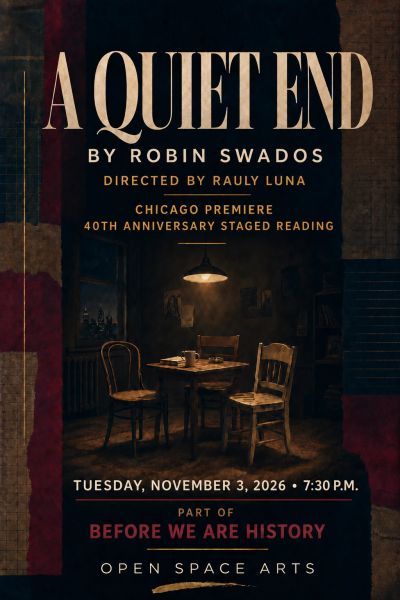
A QUIET END
By Robin Swados
Directed by Rauly Luna
Tuesday, November 3 — 7:30 p.m.
In a modest Manhattan apartment, three gay men are trying to get through another day.
One is a former teacher. Another dreams of becoming a jazz pianist. The third is an unemployed actor. All three are living with AIDS. They have endured rejection, unemployment, isolation, and the terrifying uncertainty of an illness for which there is no cure. Their shared apartment has become both a sanctuary and a place where the realities of their circumstances can never be entirely escaped.
But life goes on.
They argue about ordinary things. They joke. They remember old relationships. They worry about money and their futures. They try, in ways both large and small, to take care of one another. This is the world of Robin Swados' A QUIET END, written in 1985, during the epidemic's early years.
At a time when much of the emerging AIDS theater focused on public outrage, political protest, and social injustice, Swados created a deeply personal portrait of the people living behind the headlines. His characters are not symbols or statistics. They are complicated human beings, capable of generosity, jealousy, frustration, humor, and unexpected grace. Their relationships with one another, with a former lover, and with the world beyond their apartment reveal the extraordinary importance of friendship and chosen family when traditional systems of support have failed.
Robin Swados wrote A QUIET END in 1985, when the AIDS epidemic was still unfolding and few playwrights had begun to explore its devastating human impact. His first play, it received American and British premieres in 1986, followed by productions in Amsterdam, St. Louis, and elsewhere, culminating in a 1990 Off-Broadway production. Unlike more politically focused AIDS dramas of the period, Swados concentrated on the intimate lives of men facing illness, isolation, and loss—and the extraordinary importance of friendship and chosen family. Our research indicates it has not been performed in Chicago
Open Space Arts is especially pleased to revisit this moving work as part of BEFORE WE ARE HISTORY. Under the direction of Rauly Luna, our staged reading places the language and the relationships at the center of the experience, allowing audiences to encounter the play with unusual immediacy.
A QUIET END reminds us that the history of AIDS is not only the history of medical discoveries, political battles, and unimaginable loss.
It is also the history of people caring for one another when there was nobody else to turn to.
And sometimes, in the darkest circumstances, the simplest acts of friendship become acts of extraordinary courage.
This special reading is pay what you can. Advance reservations are strongly
SUNDAY CONVERSATIONS
Three Sunday matinees, each followed by a conversation.
- Sunday, October 25 — 3:00 p.m. ONE and BLOOD SPILL, followed by a conversation.
- Sunday, November 1 — 3:00 p.m. JERKER, followed by a conversation.
- Sunday, November 8 — 3:00 p.m. JERKER, followed by a conversation.
All three Sunday performances will be followed by conversations with artists, activists, historians, and community organizations exploring the history of the AIDS crisis, its continuing impact, and why these stories matter today.
Participants and conversation topics will be announced as they are confirmed.
WHY THIS PROJECT—AND WHY NOW?
There was a time when AIDS seemed to be everywhere in the theater. Playwrights were writing about their friends, their lovers, their communities, and sometimes their own approaching deaths. They were trying to make sense of something terrifying while it was happening around them.
These weren't history plays. They were urgent, immediate responses to a crisis that was taking lives while much of the country looked away.
Forty years later, many of those plays have nearly disappeared from our stages. And with them, we risk losing not just an important chapter in theater history, but the voices of people who fought to be seen and heard.
BEFORE WE ARE HISTORY is our attempt to bring some of those voices back into the room.
We're presenting works written during the early years of AIDS alongside a more contemporary perspective. Some are funny, some are angry, some are deeply moving, and some are unapologetically sexual. Together, they remind us that the people living through the epidemic were much more than victims. They were complicated, passionate, creative human beings who loved, fought, laughed, and refused to disappear.
For those who remember those years, these plays may bring back people and experiences we haven't thought about in a long time. For younger audiences, they offer a chance to discover a history that isn't always taught or talked about.
And for all of us, they raise a question: How do we remember a generation without allowing its stories to become just another chapter in the past?
COMMUNITY BENEFIT
Remembering this history also means supporting the people and organizations doing important work today.
Ten percent of ticket revenue from BEFORE WE ARE HISTORY, along with additional donations made in connection with the series, will be shared among three organizations:
- Chicago Black Men’s Caucus
- Vivent Health + TPAN
- Season of Concern
Each represents a different part of the ongoing work of health, advocacy, community support, and caring for people affected by HIV/AIDS and other challenges.
We're proud to connect these performances with organizations whose work continues long after the curtain comes down.
TICKETS AND LOCATION
Open Space Arts
1411 W. Wilson Avenue
Chicago, Illinois 60640
All performances take place in our intimate storefront theater in Chicago's Uptown neighborhood. With an audience of just 25 people, there's very little distance between the actors and the people watching. For plays as personal as these, we think that's exactly right.
General Admission: $30
Seniors and Students: $25
A QUIET END, presented as a special staged reading on Tuesday, November 3, is pay what you can.
Seating is extremely limited, so we strongly recommend purchasing tickets in advance.
Sandro Fullone, featured in ONE