
BEFORE WE ARE HISTORY
Before We Are History brings together three powerful programs exploring AIDS, memory, love, survival, and the lives that must not be forgotten. Presented in an intimate storefront setting, this special October–November series looks back at a generation changed forever—and asks what its stories still mean to us today.
BLOOD SPILL / ONE
BLOOD SPILL (2014) by Lee Raines and ONE (1983) by Jeff Hagedorn confront the AIDS era through love, fear, anger, memory, and survival.
JERKER
Robert Chesley’s 1986 landmark play traces the intimate relationship between two gay men who connect by telephone during the early years of the AIDS crisis.
A QUIET END
Robin Swados’ 1985 play is a moving portrait of friendship, caregiving, and chosen family among men living through the AIDS epidemic.
two short plays October 23 t0 25
BLOOD SPILL / ONE
By Lee Raines and Jeff Hagedorn
What happens when we put a play written at the very beginning of the AIDS epidemic alongside one written more than 30 years later? We discover how much has changed—and how much remains painfully familiar.
ONE (1983), by Chicago playwright Jeff Hagedorn, is among the earliest plays ever produced about AIDS. A young man, newly diagnosed with a frightening and little-understood illness, tries to make sense of what is happening to his body, his future, and the people around him. Written when misinformation and fear were everywhere, the play captures a moment before anyone knew just how devastating the epidemic would become. Hagedorn, who died of an AIDS-related illness in 1995, gave theatrical voice to the crisis almost as soon as it emerged.
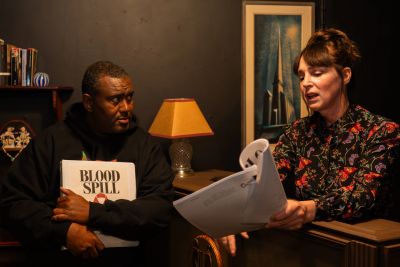
BLOOD SPILL (2014), by Lee Raines, takes us to a different confrontation. Set in 1992, it introduces Kenny King, an HIV-positive playwright who brings a deeply personal script to Angela Turner, an old college friend who now runs a successful New York theater. Their reunion becomes a sharp, sometimes uncomfortable argument about AIDS, art, friendship, and who gets to decide which stories are worth telling.
Raines, a longtime HIV survivor and former ACT UP activist, brings both personal experience and a contemporary perspective to the work. The result is a fascinating pairing: one play speaks from the terrifying beginning of the crisis, while the other asks how artists and institutions responded as it unfolded.
ONE is directed by Rory Brady and performed by Sandro Fullone. BLOOD SPILL is directed by David Zak and features Keith Butler and Tierza Scaccia.
Together, these two short plays make for an unusually compelling evening about art, survival, and the importance of speaking up.
NINE PERFORMANCES OCTOBER 29 TO NOVEMBER 8
JERKER
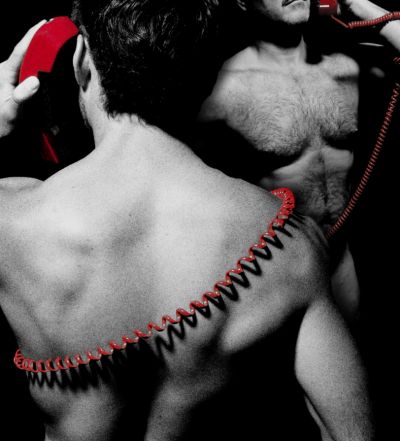
By Robert Chesley, created and performed by Jason Bowen and Joshua Bowen
Forty years after its first appearance, JERKER (1986) remains one of the most daring, funny, sexually frank, and unexpectedly moving plays to emerge from the AIDS era.
The premise is deceptively simple. Two gay men who have never met begin talking on the telephone. Their conversations are initially anonymous, playful, and intensely erotic. They share fantasies, invent scenarios, and discover what excites them. But as the calls continue, something surprising happens: beneath the sexual games, a genuine relationship begins to develop.
And all the while, AIDS is changing the world around them.
Robert Chesley was determined to challenge the idea that gay sexuality itself was something to be ashamed of. At a time when fear and death were dominating public discussion of gay men, he wrote a play that insisted on celebrating desire, pleasure, humor, and human connection. The result was provocative in 1986, and it has lost remarkably little of its power to challenge an audience today.
For this 40th-anniversary production, there's an additional dimension: the two performers, Jason Bowen and Joshua Bowen, are husbands in real life. Their personal relationship brings a special resonance to a play about two men creating intimacy
Jason's Chicago theater career includes founding Quest Theatre Ensemble, while his performance credits include the national tour of Golden Girls: The Laughs Continue. Joshua is an actor, producer, and entertainment attorney.
At Open Space Arts, where the audience sits just a few feet from the performers, the experience promises to be especially intimate. Chesley's play asks us to listen closely, laugh freely, and recognize the humanity of two men whose relationship unfolds in the shadow of an epidemic.
It's a love story unlike almost anything else in American theater.
JERKER contains explicit sexual language and mature themes.
Staged reading on November 3
A QUIET END
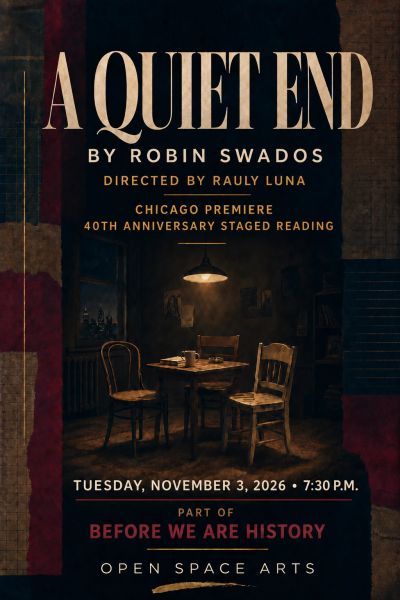
By Robin Swados, Directed by Rauly Luna
In a worn Manhattan apartment, three gay men are trying to get through another day. One is a former teacher, another an aspiring jazz pianist, and the third an unemployed actor. They've lost jobs, experienced rejection from their families, and are living with AIDS. Their apartment has become both a refuge and a place where the realities of illness cannot be avoided.
This is the world of A QUIET END (1985), Robin Swados' remarkably intimate play about friendship, caregiving, and the families we create when our own families—or society—turn away.
Unlike many AIDS plays of its time, A QUIET END isn't primarily about politics, protests, or public confrontation. Its focus is smaller and, in many ways, more personal. The men argue, joke, worry, remember, and try to maintain some sense of ordinary life. Relationships with a former lover and an unseen psychiatrist bring questions of loyalty, faith, love, and mortality into sharper focus.
First performed during the early years of the epidemic, the play eventually reached Off-Broadway in 1990 and received productions in the United States and abroad. Yet, like many significant works from that period, it has largely disappeared from contemporary theater schedules.
That's one reason we're especially pleased to bring it to Chicago as part of BEFORE WE ARE HISTORY.
Directed by Rauly Luna, our special staged reading gives audiences a rare opportunity to experience this important work in the intimate setting of Open Space Arts. Without the elaborate scenery of a full production, the focus is on the actors, the language, and the relationships at the heart of the play.
At its core, A QUIET END reminds us that even during a catastrophe, people still need laughter, companionship, forgiveness, and love. And sometimes the smallest acts of caring become the most extraordinary.
This special reading is pay what you can, with advance reservations recommended.
SUNDAY CONVERSATIONS
The plays don't have to end when the lights come up.
Selected Sunday performances will be followed by conversations with artists, activists, historians, and community organizations. We'll talk about what it was like to live through the early years of AIDS, the extraordinary ways people came together to care for one another, and what younger generations may not know about that history.
We'll also look at HIV/AIDS today—what has changed, what hasn't, and why these stories still matter.
Participants and conversation topics will be announced as they are confirmed.
WHY THIS PROJECT—AND WHY NOW?
There was a time when AIDS seemed to be everywhere in the theater. Playwrights were writing about their friends, their lovers, their communities, and sometimes their own approaching deaths. They were trying to make sense of something terrifying while it was happening around them.
These weren't history plays. They were urgent, immediate responses to a crisis that was taking lives while much of the country looked away.
Forty years later, many of those plays have nearly disappeared from our stages. And with them, we risk losing not just an important chapter in theater history, but the voices of people who fought to be seen and heard.
BEFORE WE ARE HISTORY is our attempt to bring some of those voices back into the room.
We're presenting works written during the early years of AIDS alongside a more contemporary perspective. Some are funny, some are angry, some are deeply moving, and some are unapologetically sexual. Together, they remind us that the people living through the epidemic were much more than victims. They were complicated, passionate, creative human beings who loved, fought, laughed, and refused to disappear.
For those who remember those years, these plays may bring back people and experiences we haven't thought about in a long time. For younger audiences, they offer a chance to discover a history that isn't always taught or talked about.
And for all of us, they raise a question: How do we remember a generation without allowing its stories to become just another chapter in the past?
COMMUNITY BENEFIT
Remembering this history also means supporting the people and organizations doing important work today.
Ten percent of ticket revenue from BEFORE WE ARE HISTORY, along with additional donations made in connection with the series, will be shared among three organizations:
- Chicago Black Men’s Caucus
- Vivent Health + TPAN
- Season of Concern
Each represents a different part of the ongoing work of health, advocacy, community support, and caring for people affected by HIV/AIDS and other challenges.
We're proud to connect these performances with organizations whose work continues long after the curtain comes down.
TICKETS AND LOCATION
Open Space Arts
1411 W. Wilson Avenue
Chicago, Illinois 60640
All performances take place in our intimate storefront theater in Chicago's Uptown neighborhood. With an audience of just 25 people, there's very little distance between the actors and the people watching. For plays as personal as these, we think that's exactly right.
General Admission: $30
Seniors and Students: $25
A QUIET END, presented as a special staged reading on Tuesday, November 3, is pay what you can.
Seating is extremely limited, so we strongly recommend purchasing tickets in advance.

Sandro Fullone, featured in ONE